
Laser-free method to fix vision without cutting the eye
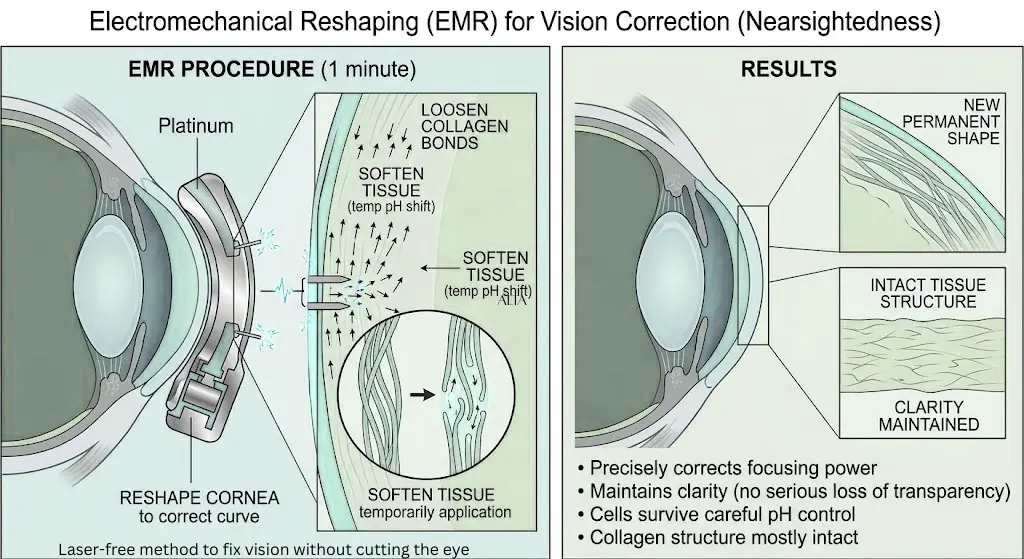
If you ask anyone who has undergone LASIK, they will all tell you the same thing: it works, but the thought of a laser touching your eye never quite goes away. Additionally, it is pricey. Therefore, it is worth paying attention when a group of researchers claims to have discovered a method for correcting nearsightedness using only electricity, no blade, no laser, and no tissue removal. Both Occidental College and the University of California, Irvine are responsible for the work. They’re calling it electromechanical reshaping, or EMR. It’s still at the animal-testing stage, tried so far only on rabbit eyes in a lab, but the early numbers are interesting enough that eye specialists are starting to talk about it.
The Reasons Why Researchers Desired a LASIK Alternative:
LASIK is effective, but it permanently removes corneal tissue, which can structurally weaken the eye and cause side effects like nighttime halos. To address this, researchers Michael Hill and Brian Wong investigated whether corneal tissue could be reshaped non-surgically, like clay, rather than being cut away.
The Science of Using Electricity to Bend an Eye:
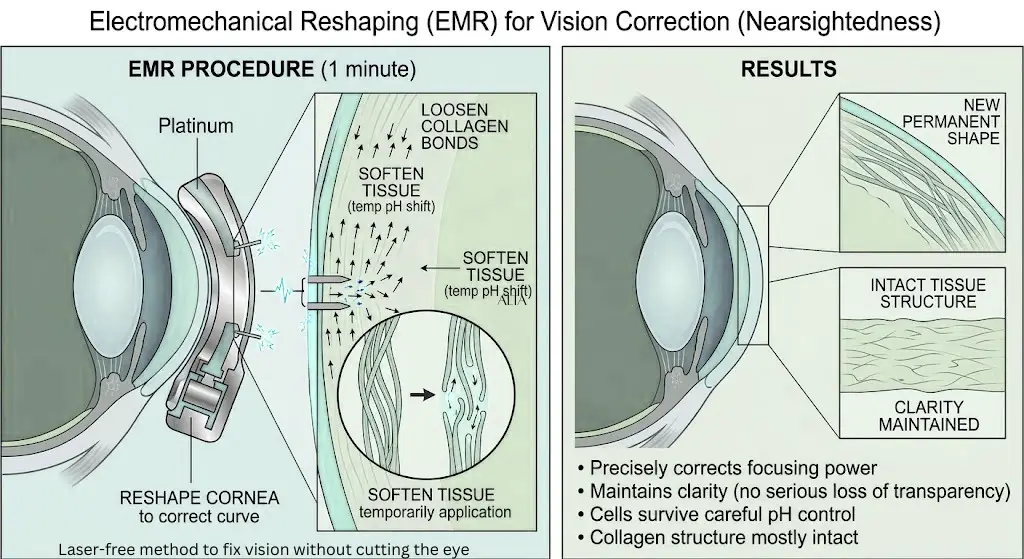
Applying a mild electric current temporarily alters the cornea’s pH, loosening the collagen bonds so the tissue can be physically reshaped. In tests on rabbit eyes, researchers used custom platinum contact lenses and an electric pulse to re-mold the cornea to a new curve in about a minute without any cutting. Once the current stops, the collagen locks back into its new shape.
What The Tests Actually Found
Twelve rabbit eyes went through testing. Ten were treated to correct simulated nearsightedness, and in those cases, the cornea reshaped itself to the exact focusing power the team was aiming for.
A few other things stood out once researchers looked closer:
– The internal collagen structure stayed mostly intact rather than getting damaged.
– The cornea kept its clarity, with no serious loss of transparency.
– Cells inside the treated tissue survived the process, since the pH shifts were carefully controlled the whole time.
There was also a surprise finding tucked into the same research. In a separate set of tests, the same electrical method appeared to reduce certain kinds of corneal clouding, a problem that usually requires a full corneal transplant to fix. That’s a completely different use case from correcting nearsightedness, but it hints the technique might have a wider range of uses than originally expected.
The Bigger Appeal, If It Works Out
Assuming this eventually clears human trials, the advantages are fairly obvious. No tissue removal likely means less risk of the cornea weakening over time. It also wouldn’t need the expensive laser systems LASIK clinics rely on, which researchers believe could make it noticeably cheaper.
There’s early talk of adapting the same idea for farsightedness and astigmatism too, and possibly even reconstructive procedures involving other collagen-rich tissue elsewhere in the body.
Interestingly, Wong mentioned the discovery wasn’t even something the team was originally chasing. He came across the effect while studying other tissues, like cartilage, as moldable materials, and only later did it become clear the cornea might respond the same way.
Still A Long Way From Your Local Eye Clinic
None of this means EMR is anywhere near ready for actual patients. Every test so far has been done on isolated rabbit eyes in a controlled lab setting, not in a living animal and certainly not in a person. The next phase involves testing on living eyes to see whether the reshaped cornea holds up over months or years, and whether the process is genuinely safe outside a lab dish.
Hill was upfront about that gap, saying there’s still a long road between the lab work they’ve done and an actual clinic. But if it eventually gets there, he believes the method could prove widely usable, far cheaper than current options, and potentially reversible in a way LASIK never can be.
For now, LASIK remains the standard choice for anyone looking at surgical vision correction. But this research points toward a future where fixing blurry eyesight might not need a laser, or a blade, at all.
**Source:** Based on research originally reported by the American Chemical Society and published on ScienceDaily. Original release and for more detail, click here
you must read this article
