
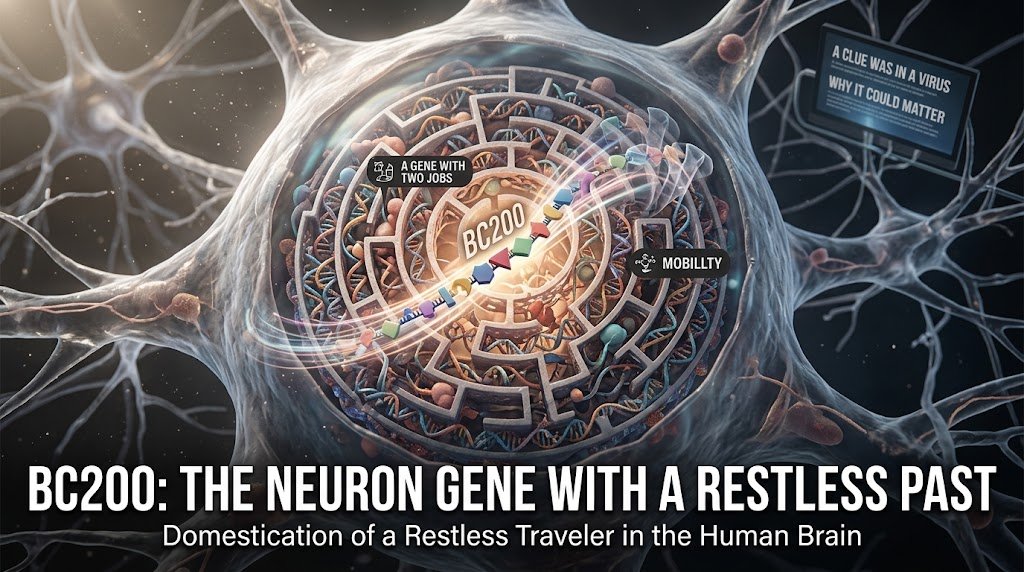
The Brain Gene That Never Stopped Moving
Most of your DNA isn’t really yours—well, not in the way you might think. About half of the genome is made up of fragments from transposons, pieces of genetic material that used to copy and paste themselves around the genome. Scientists call these “jumping genes.” Over time, most of them stopped moving. Mutations turned them into fossils. They’re still there. They no longer jump.
Now researchers at Cornell University have found one that hasn’t stopped. It’s in the brain.
A gene with two jobs
The gene is called BC200. It’s been known since the 1980s as a non-coding RNA—meaning it doesn’t make proteins. Instead, it floats around in brain cells, neurons, and seems to help control how messages from DNA get turned into proteins. Its exact job is still debated. That’s not the surprising part.
What’s surprising is that BC200 can still move. That’s a deal because, in general,l when a jumping gene gets repurposed for a useful function in the body, it loses its ability to jump. The two traits—usefulness and mobility—don’t usually go together. BC200 seems to have both.
Cedric Feschotte, one of the researchers, put it simply: Evolution never managed to separate BC200’s usefulness from its ability to move.
The clue came from a place: a virus.
The team found a copy of BC200 inside the genome of a poxvirus—the one that causes molluscum contagiosum, a common skin infection. A human gene in a virus? That’s something that makes geneticists sit up straight.
Such transfers between host and virus aren’t unheard of. Back in the 1980s, scientists saw a transposon jump from moth cells into a baculovirus. This case is different. BC200 is found in humans and our closest primate relatives. So this virus must have picked it up from a primate cell.
The researchers think this happened in skin cells—the place this virus is known to infect. As the virus replicated it accidentally copied BC200. That copy ended up in the viral DNA. The study, published September 24 in Science, argues that this viral theft is proof that BC200 has been moving around in primates for a time.
Why does this matter?
Well, BC200 has also been detected at levels in sperm and egg cells. That’s important. If a gene is active in cells, it could jump into the genome of future offspring. In theory,y it could create genetic changes passed down through generations.
There’s also an angle. BC200 is found at levels in some cancers, like breast cancer, and in the brains of people with Alzheimer’s. If BC200 is still jumping around in these conditions, it might be causing DNA damage. Helping drive mutations. Right now that’s just a question. No proof yet.
Next,xt the team plans to see if the molluscum virus uses its stolen copy of BC200 to change how human cells behave. They also want to look for signs of jumping in cancer cells.
The big picture?
Your DNA carries a surprising amount of ancient clutter. Nearly half of the human genome comes from jumping genes, fragments of code that once copied themselves from place to place before falling silent over millions of years. Scientists had long assumed that once such a fragment becomes a useful gene, it stops moving for good. A new study from Cornell University challenges that idea, revealing a brain gene that does real work in neurons and yet still seems able to travel.
How much this affects health is still unknown. For now, it’s a powerful example of just how dynamic and unpredictable the genome can be.
