WHO Extends Polio Travel Rules On Pakistan
If you have a flight booked out of Pakistan in the coming weeks, this one affects you directly. The World Health Organization has kept its polio-related travel restrictions on Pakistan in place for three months, saying the virus is still circulating and hasn’t stopped crossing the border with Afghanistan.
It’s not a rule. Pakistan has lived with it since 2014. Every time it gets renewed, the same questions come up. Why again? Who needs the certificate? What’s actually going wrong on the ground? Let’s go through them one by one.
What did the WHO actually say?
The decision came out of a review by the WHO’s Emergency Committee on polio. The members agreed that the spread of poliovirus across borders remains a Public Health Emergency of International Concern. That label has been attached to polio for years. The WHO Director-General signed off on the committee’s advice, meaning the temporary recommendations will continue for another quarter.
The virus in question is poliovirus type 1 (WPV1). The WHO treats Pakistan and Afghanistan like one big outbreak area. People, families and traders cross that border all the time. The virus travels along with them.
Where it’s still spreading
Three places came up again and again in the WHO’s assessment: Karachi, southern Khyber Pakhtunkhwa and the Quetta block. The virus keeps coming into KP and Quetta from Afghanistan, while in Karachi and southern KP it continues to spread locally.
Karachi got the language. The WHO called it a stronghold for transmission and called for targeted vaccination drives in the Central Pakistan block, southern KP, and Quetta.
The numbers this year look small at a glance. A few human cases have been reported in both countries. So far in 2026, 57 Sewage samples in Pakistan have tested positive for WPV1, and health officials watch that figure closely because it shows the virus is still out there even when few children get visibly sick. The committee also cautioned that fewer cases shouldn’t be taken as proof that campaigns are reaching the standard needed to finish the job.
Why some children are still being missed
There are two reasons, and neither has an easy fix.
The first is security. According to the WHO, around 250,000 children in Khyber Pakhtunkhwa haven’t been vaccinated because insecurity keeps health teams out of certain areas. That same region is where transmission is currently the most intense in the country.
The second is refusal. Some families refuse the vaccine, and in a few communities overall coverage is low. The WHO named vaccine refusal as an obstacle.
Pakistan and Afghanistan are the two countries where wild polio is still considered endemic. Pakistan held a drive in early February, and media reports put the number of children targeted at over 44 million. Afghanistan ran its campaign the same week. Still, the WHO says campaign quality remains uneven in high-risk districts.
What you need to do if you’re traveling
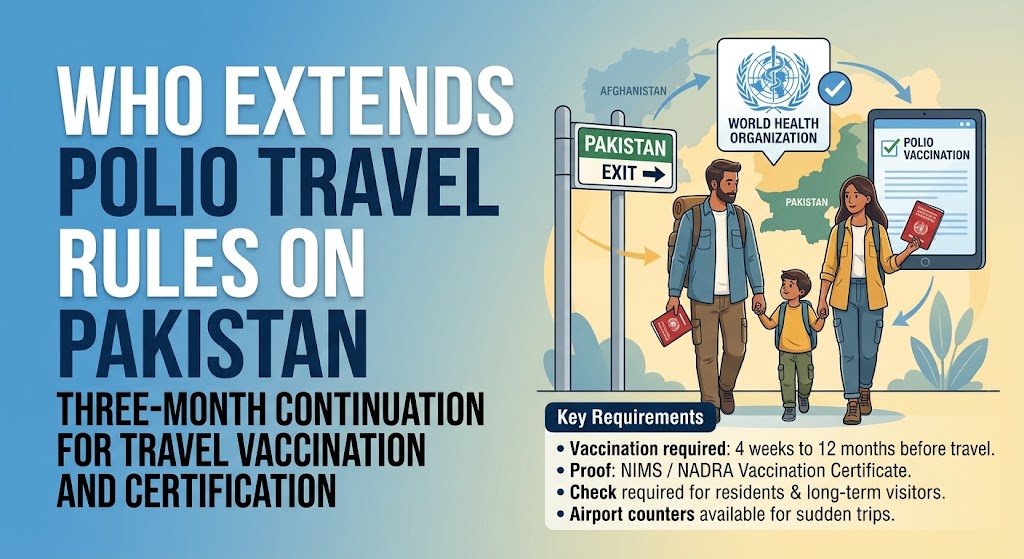
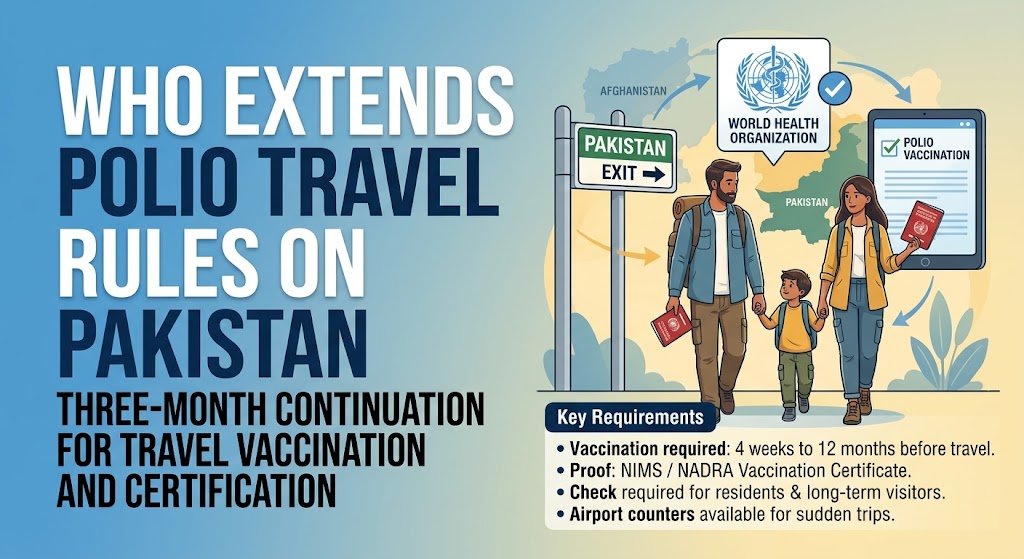
Anyone leaving Pakistan, whether a resident or a long-term visitor, must receive a polio vaccine dose no earlier than 12 months and no later than 4 weeks before the trip. You also need the International Certificate of Vaccination or Prophylaxis, which comes through the NIMS system connected to NADRA.
A few things people often get confused about:
- The certificate is only checked when you leave. Nobody asks for it when you arrive in Pakistan, according to the Polio Free Pakistan portal.
- If you’re visiting Pakistan for more than four weeks, you don’t need proof.
- If your trip came up suddenly and you haven’t had a dose within the window, the WHO advises that you get one before you depart. Vaccination counters have been set up at airports for this.
- Airport checks have reportedly become stricter. Carry your NIMS certificate and check the current requirements with your airline or on the official portal before you head to the airport.
My advice if you’re flying soon is to sort this out a couple of weeks early. Standing at an airport hours before departure is no way to start a trip.
What comes next
The WHO wants surveillance, higher-quality campaigns and closer coordination between Islamabad and Kabul. It noted that both countries have been running campaigns at the time, which it sees as a good sign,n but the real test is whether vaccinators can get to the children who are still unprotected.
The global target is to stop poliovirus transmission in these two countries. Each extension of the travel rules reminds us that the finish line hasn’t been reached yet.
For travelers, the fix is simple: a vaccine. A certificate. For the country, the harder work is happening in Karachi, southern KP, and Quetta, where every child who gets missed keeps the virus alive a little longer
Frequently asked questions
How long is the extension?
Three months, based on the Emergency Committee’s recommendation and the Director-General’s approval.
Who needs the polio certificate?
Pakistani. Long-term visitors traveling abroad from Pakistan. Visitors staying for more than four weeks are exempt.
When should I get the dose?
Between four weeks and twelve months before you travel. For trips, the WHO recommends getting it before departure.
Is the certificate needed to enter Pakistan?
No, only those people leaving the country who are asked for it.
Which areas is the WHO worried about?
Karachi, southern Khyber Pakhtunkhwa, the Quetta block, and southern Afghanistan.
Focus Keyword: WHO polio travel restrictions Pakistan
Sources:
- The Nation: WHO extends travel restrictions on Pakistan over polio threat
- Daily Pakistan: Pakistan faces WHO’s travel restrictions over polio threat
- 24 News HD: WHO extends Pakistan’s polio-related travel restrictions for three months
- WHO: Statement of the 45th Meeting of the Polio IHR Emergency Committee
- Polio-Free Pakistan: Vaccination Certificate
READ IT FOR INSURANCE PLAN INFORMATION. CLICK
