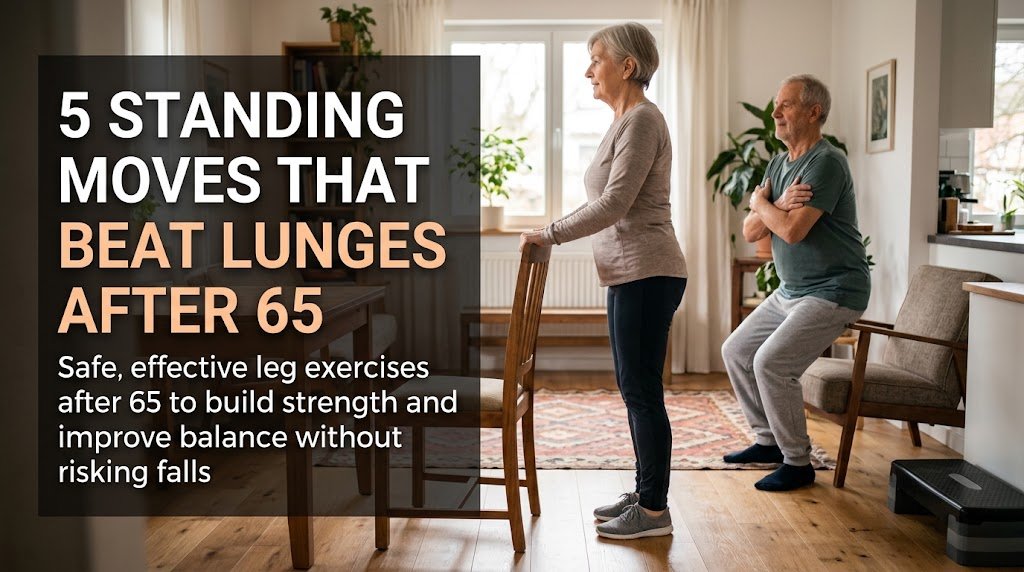
5 Standing Moves That Beat Lunges After 65
Most people don’t realize their legs are getting weaker until it happens on a Tuesday, when getting out of the car feels like a light workout. Then stairs start to feel like a workout instead of something you climb. This isn’t just a natural part of aging; it’s a loss of leg strength. Actually, it is one of the easiest problems to remedy once you know the correct steps.
The most common answer people give is lunges. Lunges do provide a worthwhile exercise. They require good balance and coordination. After age 65, many people lack confidence in their balance. For this reason, a simpler series of standing exercises can build the same kind of strength without risking balance.
I spoke with Dr. Marcin Jez, a therapist at Anchor Wellness, about why these specific standing exercises work better for people over 65. He pointed out that you can make standing exercises harder or easier by changing how far you move or how much support you use, and that they also mimic activities like standing up from a chair or walking up a set of steps. Hence, the benefits show up in real life quickly.
Here’s what he recommends.
Sit-To-Stands
Even though it seems simple, a single sit-to-stand movement works the quads, glutes, hips, and core at once. These muscle groups help you stand up, climb stairs, and stay independent as you get older.
Sit on the edge of a sturdy chair with your feet about hip-width apart, cross your arms with your hands on your shoulders, lean forward slightly, push through your feet to stand up straight, then lower yourself slowly by dropping straight down into the seat.
Step-Ups
This exercise works each leg separately, which helps improve balance by mimicking a daily movement, such as walking up stairs.
Face the step and place one foot firmly on it; keep your core engaged and chest up. Push through the heel until the leg is fully straightened and you are fully on the step. Descend in a controlled manner and then switch to the other leg. Aim for one minute per side.
Calf Raises
Small effort brings a big reward; when you walk, keep your balance or push off with each step, the calf and ankle muscles work more than most people realize.
Keep your posture upright with your feet about hip-width apart, place one hand on the wall for support, tighten your core, then rise slowly onto your toes and hold for one second before lowering yourself over three seconds.
Chair-Supported Split Squats
This exercise focuses on each leg individually and helps correct imbalances that can develop over time.
one hand on a chair or counter. Take one foot forward by two to three feet to assume a staggered position. Bend both knees to lower yourself, then push off through the heel to stand up. Then do the other foot. Keep doing this.
Single-Leg Balance
This exercise emphasizes stability over strength; it also targets the feet, ankles, and hip stabilizers, which can help you catch yourself if you trip.
Stand near a counter with your feet about hip-width apart, and keep your arms loose. Contract your core, shift your weight onto one leg, and then lift the foot slightly off the ground. Hold this position for ten to thirty seconds, then switch legs.
Why This Approach Actually Makes Sense
The real benefit isn’t that these standing exercises are easier than lunges; it’s that you can adjust them in ways lunges generally can’t. Someone who is out of practice or nervous about falling can start with support and a smaller range of motion. From there, they can gradually increase the intensity as their confidence is restored. This kind of adjustability often makes the difference between continuing an exercise routine and giving up out of fear of injury.
Combining strength exercises with balance training, such as these standing exercises, is beneficial. It improves physical function and reduces the risk of falls in older adults, which is the goal.
Bottom Line
People over 65 need neither a gym membership nor special equipment to do leg exercises. All you need to start leg exercises after age 65 is a chair, a step, and a wall to hold on to. Leg exercises for people over 65 work only when you attend regularly, not when you put in a hard effort once and then exhaust yourself. The benefits come from consistent, steady effort, not intense bursts.
Source: This information is based on expert insights from Dr. Marcin Jez, PT, DPT, and was shared through Eat This, Not That!
You must read the healthy kabab recipe.
Disclosure: This article is for informational purposes only and isn’t a substitute for professional medical advice. It also contains an affiliate link — if you purchase through it, I may earn a small commission at no extra cost to you.
This product helps you with your exercise. If you are interested, click the link.
