
Turns Out Your Brain Isn’t One Organ.
Here is something that will mess with how you think about your own head. For as long as anyone has studied the brain, scientists assumed the brain was one single organ, built from one starting point growing outward as a unified whole. New research out of Stanford Medicine just flipped that idea down.
Turns out the brain is not one thing pretending to be whole. The brain is actually two organs that formed independently hundreds of millions of years ago, and somewhere along the evolutionary timeline those two organs ended up fused together into what we now casually call the brain.
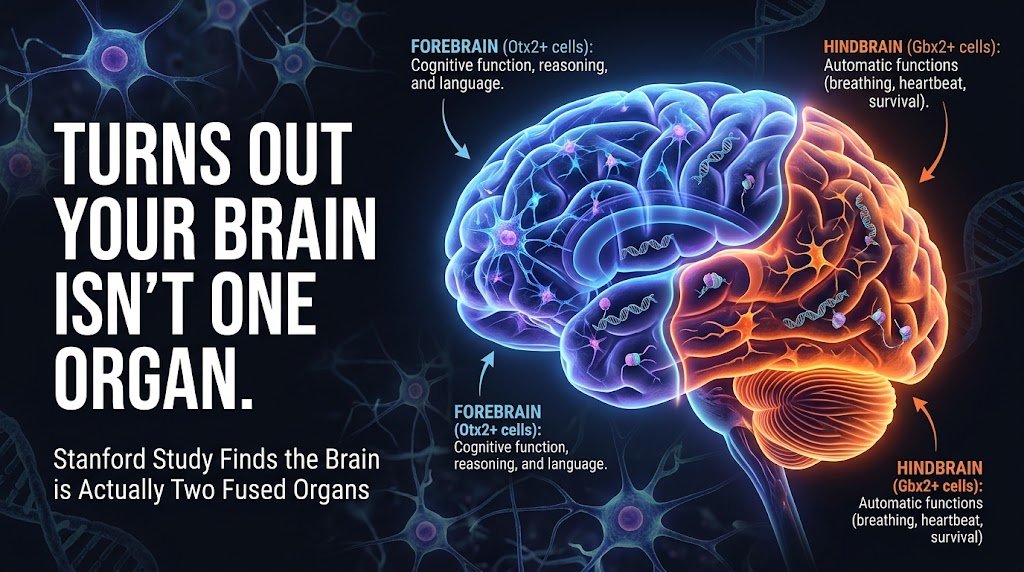
Two Brains, Not One
The research led by developmental biologist Kyle Loh, along with researchers Carolyn Dundes and Rayyan Jokhai, dug into the earliest moments of embryonic development, well before anything resembling a brain actually exists. What they found was that the part of the brain responsible for things such as language, reasoning, and basically everything that makes human thought feel human comes from a completely different starting cell than the back part of the brain.
That back part, called the hindbrain, is not concerned with poetry or math. The hindbrain handles the boring but absolutely critical stuff: breathing, heartbeat, sleep, hunger, even muscle control needed for speaking and swallowing. According to this study, the hindbrain region never shared a common origin with the thinking part of the brain at all. The front part of the brain developed side by side, like two separate rail tracks that never once crossed.
Why Scientists Never Noticed This Before
This might be the interesting part, honestly. For decades, researchers struggled to grow neurons in a lab setting, and nobody really understood why. Turns out researchers were trying to force one type of progenitor cell to transform into something it was never biologically capable of becoming in the place.
Jokhai put it simply: earlier attempts were essentially trying to push forebrain cells into becoming something the new findings show is not possible. Once the team understood that these two brain regions come from separate progenitor cells, one marked by a gene called Otx2 and the other by Gbx2, everything clicked into place. DNA packaging inside each cell type, something scientists call chromatin, was fundamentally different too, essentially locking each cell into its developmental path from the very beginning.
What This Actually Means For Medicine
This is not a cool biology fact for trivia night. Being able to grow real hindbrain neurons in a lab could open doors that have been stuck shut for decades, especially for diseases such as ALS and spinal muscular atrophy, both of which damage this specific region of the brain.
These are not conditions either. Spinal muscular atrophy is one of the leading causes of death in infants under a year old. ALS usually shows up later in life. Slowly takes away a person’s ability to swallow, speak, and eventually breathe. Scientists have had a hard time studying either condition properly, mainly because there was never a reliable way to study living hindbrain tissue outside the human body.
Now that researchers have successfully grown functioning hindbrain motor neurons using stem cells and confirmed these lab-grown cells actually behave like real neurons, that barrier has come down. There is an unexpected connection to weight loss treatment here too since the hindbrain plays a role in regulating hunger, which happens to be exactly how drugs such as semaglutide work in the first place.
The Evolution Angle Is Honestly Wild
Researchers did not stop at humans either. They traced this two-origin pattern back through evolutionary history, finding it in chickens, zebrafish, and even in acorn worms living on ocean floors — creatures that share an incredibly distant common ancestor with us. Even jellyfish, separated from humans by something like 600 to 700 million years of evolution, show a split with two separate nervous systems, at opposite ends of their bodies.
Loh explained that evolution essentially took two existing nervous systems and pushed them together physically over time. A single unified brain might technically be more efficient. That is not the path evolution ended up taking with us.
Where This Goes From Here
The team is not stopping here. The team is now looking into how the spinal cord fits into this picture and digging deeper into how conditions such as ALS and SMA damage hindbrain neurons, at the cellular level. For the first time, there is an actual working model to study these devastating diseases directly, rather than studying things together indirectly.
It is a thing to sit with, honestly. The brain is two organs feels like the you” part of you, and yet the brain is two organs turns out that feeling of unity is sort of an illusion: two separate systems, one ancient and automatic, one distinctly human that evolution simply decided to squeeze together into a single skull.
Source: A Stanford study published in Nature Neuroscience, reported via EurekAlert!
HERE IS THE ARTICLE FOR THOSE WHO WANT TO LOSE WEIGHT
This article is based on research findings originally reported by Wellbeing804, covering a study on how fat cells retain a biological memory of obesity even after weight loss.
